BeNeDrone (Belgium–Netherlands Drone) is a cross-border research and innovation project that explores how medical drones can responsibly support emergency response and healthcare logistics in Flanders and the Southern Netherlands—one of Europe’s most complex areas for drone operations, where borders, ports, cities, and coastline meet.
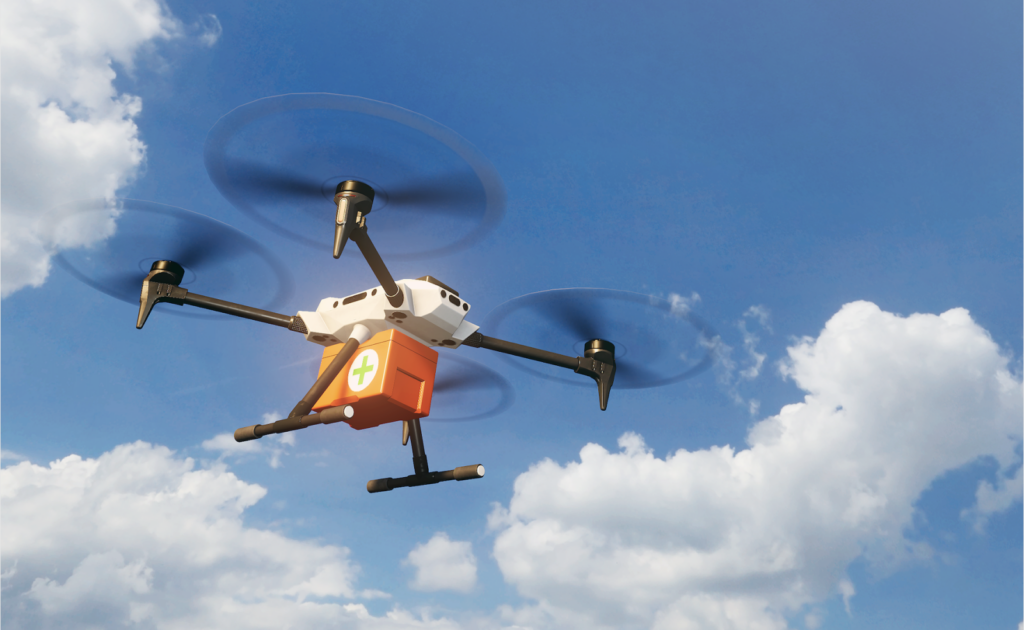
Drones could deliver time-critical medical goods—think AEDs, blood products, urgent medication, and donor organs—by bypassing traffic and physical barriers on the ground. But turning that promise into something hospitals and regulators can rely on requires answers to the hard questions: When is a drone truly faster? Which route is both safe and legal? What changes when a flight crosses a national border?
BeNeDrone is built around those “questions before the first real flight”: it combines data science and virtual/VR simulation to measure medical and economic value under realistic constraints, while simultaneously preparing professionals and authorities for safe deployment.

Scientific impact
BeNeDrone develops and validates a decision framework for medical drone deployment that goes beyond simple “shortest path” route planning. Instead, it models what happens when real constraints apply: no-fly zones, restricted airspace, route detours (e.g., avoiding cities or highways), weather conditions, and cross-border rules. This allows researchers and stakeholders to test whether a theoretical time gain survives in practice—and under which policy scenarios drone logistics becomes genuinely beneficial.
A key contribution is methodological: the project uses simulation-first evaluation to study routes that drones are not yet permitted to fly in the real world. In other words, BeNeDrone creates evidence for policy and operational choices before scaling physical infrastructure or changing care pathways.
Societal impact
If drones can safely and legally deliver critical goods faster, the societal benefit is direct: reduced emergency response times and improved patient outcomes, especially in regions where geography makes road logistics slower or less reliable. Zeeland is often cited as an example: long distances, water, and complex infrastructure can make “last-mile” and inter-hospital transport time-consuming—exactly the kind of setting where drones might add value, if the system is designed responsibly.
Just as important, BeNeDrone treats medical drones as a socio-technical system, not a gadget. The project explicitly includes logistics, regulation, and societal acceptance—because even a perfect drone can’t help patients if it can’t be integrated into clinical workflows, permitted under aviation rules, and trusted by the public.
Partners
BeNeDrone brings together a cross-border consortium spanning universities, hospitals, creative/tech studios, and a drone test centre, including Maastricht University, Tilburg University, KU Leuven, multiple hospitals (e.g., Maastricht’s academic hospital, UZA, ETZ, Adrz), and the Dutch Drone Centre Aviolanda.
Hospitals contribute clinical realities (chain-of-custody, urgency profiles, handover procedures), researchers build the decision logic and evidence base, and drone/simulation specialists make sure the scenarios behave like the world they are meant to represent.
European Union
The EU’s Drone Strategy 2.0 sets a direction toward a more mature European drone ecosystem—balancing market development with safety, security, and public trust. BeNeDrone fits into that trajectory by producing validated methods, tools, and stakeholder-ready procedures for one of the most sensitive and high-value use cases: medical missions.
For more information visit https://interregvlaned.eu/benedrone
Press coverage
- BeNeDrone: onderzoek naar medische drones in de zorg — Adrz (5 Feb 2026)
- BeNeDrone-project richt zich op de vragen vóór het vliegen — ICT&health (27 Oct 2025)
- Medische drones getest in virtuele ruimte: BeNeDrone onderzoekt potentie in dichtbevolkte regio’s — Link Magazine (16 Oct 2025)
- Onderzoek naar mogelijkheden medische drones in dichtbevolkt gebied — Tilburg University (12 Oct 2025)
- Research on the possibilities for medical drones in densely populated areas — Tilburg University (12 Oct 2025)
- Twee grensoverschrijdende Interreg-projecten zetten technologie in voor inclusie en medische noodhulp — DVO (10 Jul 2025)
- Interreg Vlaanderen-Nederland keurt nieuwe technologie-projecten goed — Engineeringnet (9 Jul 2025)
- Grensverleggende technologie voor een betere samenleving — Interreg Vlaanderen-Nederland (9 Jul 2025)
- Voor acht Zeeuwse projecten kan droom werkelijkheid worden dankzij Europees geld — Provincie Zeeland (25 Jun 2024)
- Besluit over oproep 3 — Interreg Vlaanderen-Nederland (25 Jun 2024)
- Onderzoek naar medische drones in dichtbevolkt gebied — Beste-ID (republished)
- BeNeDrone-project richt zich op de vragen vóór het vliegen — ZorgBOTS (republished from ICT&health)
- Over BeNeDrone — Interreg Vlaanderen-Nederland
- Werkpakketten — Interreg Vlaanderen-Nederland
- Partners — Interreg Vlaanderen-Nederland
- BeNeDrone project — UZA
- BeNeDrone — EFRO — KU Leuven
- BeNeDrone – Interreg (2025–2028) — Maastricht University (CRIS)
- BeNeDrone: Cross-border innovation in medical drone deployment — BISS Institute
- INTERREG BeNeDrone Project — LuGus Studios
- BeNeDrone – Cross-Border Medical Drone Innovation — Sakari Games
- BeNeDrone — Campus Vesta
- BeNeDrone — Campus Vesta (EN)